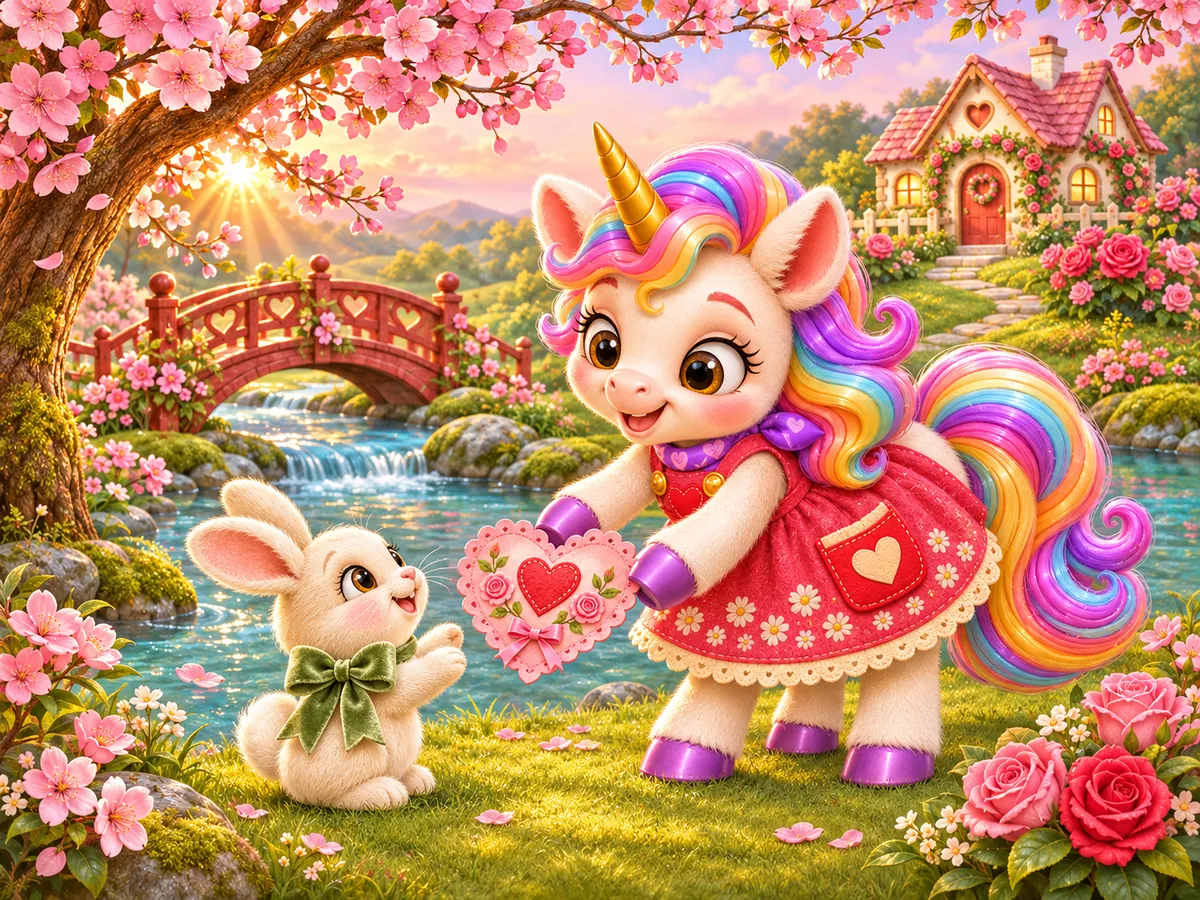
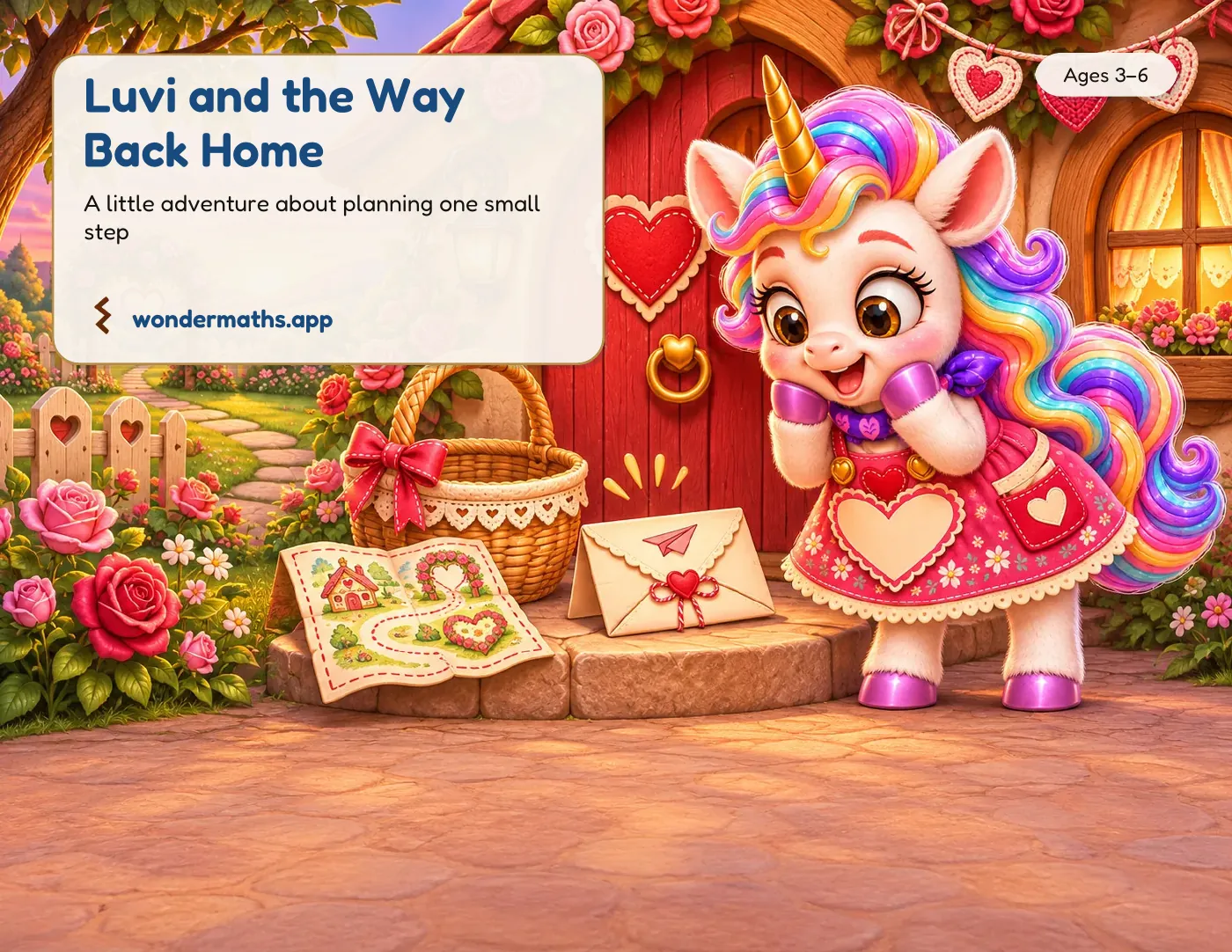
Luvi wears her pink heart apron dress and purple neckerchief, holding a Valentine heart beside her flower-covered cottage.

Valentine’s
Day

Little hearts. Big discoveries.

Share cards, sort hearts,
and find two matching halves.

A Valentine mail workshop with a parchment noticeboard, a sunlit craft table, and a heart-shaped mailbox.

One card for everyone

One friend. One card.
Nobody left out.

Open the guide
A small example: one card beside each recipient.
Card-sharing guide

A little card. A thoughtful match.

Who will get a card today? Let your child deliver one to each person, stuffed animal, or family photo. Every recipient gets exactly one.

Math to notice: One-to-one matching · Numbers & Counting · L1

Gather a few things

Scrap paper or blank cards, crayons, and two or three willing recipients, stuffed animals, or family photos.

How to play together

  1. Choose a small group of recipients together. Put them in view with a little space between them.
  2. Offer a pile of paper cards. Let your child choose and decorate one, then place it beside a recipient.
  3. Continue until your child thinks everyone has a card. Let them decide when to stop.
  4. Visit each recipient together. Look for anyone with no card or more than one, and let your child make a change.

An easier beginning

Begin with two stuffed animals and plain paper cards. Deliver beside each animal so the matches stay visible.

For the next try

Add one more recipient after the first delivery. Ask your child what needs to change, then let them fetch another card.

Leave room for discovery

“How could we check that everyone has one?”

Point to the whole group and pause. If more help is needed, visit the recipients one at a time together, without placing the cards for your child.

What to look for

Look for your child checking each recipient, rather than using the size of the pile to decide. Counting aloud is welcome, but this play is about making one match for each recipient.


Choose another activity
A warm wooden sorting desk with a hanging sign, a parchment noticeboard, and pink craft supplies.

Sort the hearts

Red with red. Pink with pink.
What else could go together?

Open the guide
One possible rule: sort by color. The words name each group.
Heart-sorting guide

Same hearts. A new way to look.

Make a cheerful jumble of paper hearts. Choose one feature to look at, then discover which hearts belong together.

Math to notice: Sorting by one attribute · Sort & Data · L1–L2

Gather a few things

Paper hearts in two colors and two sizes, plus two plates or spaces on the table. An adult can cut the hearts beforehand.

How to play together

  1. Mix the hearts. Choose one rule together: color or size. Start with just one feature.
  2. Place one example heart in each group. Say the rule aloud: “Red hearts here. Pink hearts here.”
  3. Invite your child to place the remaining hearts. Keep the groups visible and allow them to move any heart.
  4. Ask your child to show how each heart follows the rule. Mix the hearts and try a different rule if they want to.

An easier beginning

Start with two clearly different colors and a few hearts of the same size. If color is hard to distinguish, use large and small hearts instead.

For the next try

Use the same hearts but switch from color to size. A heart that was beside a red heart may now belong beside a pink one.

Leave room for discovery

“What is the same about the hearts in this group?”

Repeat the chosen rule and compare one undecided heart with an example. Ask what your child notices before naming a place for it.

What to look for

Look for a consistent rule. A different sensible grouping can work too—ask your child to explain it. Switching rules changes the groups, not the hearts.

Choose another activity
Luvi in her Valentine apron dress beside an open book in a rose-covered paper atelier.

Two halves, one heart

Fold it closed.
Do the edges match?

Open the guide
Fold along the line. The sides match.
Heart-folding guide

Fold, open, and find the match.

A folded piece of paper holds a lovely surprise. Open a heart and explore how its two sides match across the fold.

Math to notice: Reflection symmetry · Shapes & Space · L2

Gather a few things

Paper, crayons, and child-safe scissors used with an adult. An adult can prepare a folded and cut heart in advance.

How to play together

  1. Fold a piece of paper in half. With the fold as the straight edge, an adult draws and cuts half a heart through both layers.
  2. Let your child open the paper. Trace the fold with a finger, from the dip at the top to the point at the bottom.
  3. Fold the heart closed again. Look at how the two outside edges lie on top of each other. Open it and try once more.
  4. Cut a second folded heart. An adult cuts it along the fold, then invites your child to bring the two halves together again.

An easier beginning

Offer one already-cut heart. Let your child open and close it slowly. The matching outside edges are the discovery.

For the next try

Prepare two folded hearts in clearly different sizes. Cut each along its fold, mix the four pieces, and find the halves that make matching hearts.

Leave room for discovery

“What do you notice when we fold the heart closed?”

Return to the fold and slowly close the paper together. Let your child compare the edges. With loose halves, offer just the two pieces from one heart first.

What to look for

The fold is a line of symmetry because the two sides match when folded onto each other. Two pieces are not automatically matching halves; test their size and outline.

Choose another activity
Materials for all three

A small supply list for all three activities. Use scrap paper and make the hearts yourself. No printer needed.

A grown-up handles cutting or stays beside the child while using child-safe scissors.

Your materials

Check off what you have.

A changed mind, a moved heart, or a second look can be part of the discovery. Give your child time to try, notice, and try again.

Explore more everyday play

Play & explore with Luvi

Find matching Valentines, piece together pictures, decorate cards, measure ribbons, or share the mail.

Luvi holds up two rose cards above a wooden table covered with Valentine memory cards.

Memory & Matching · 5 levels

Luvi: Valentine Memory

Find matching Valentine pictures across five levels, with two to six pairs.

Play & explore
Luvi gives a rabbit a Valentine beside a red bridge and a flowering tree.

Shapes & Space · L1–L3

Luvi: Valentine Picture Puzzles

Fit the pieces together to reveal fifteen illustrated Valentines.

Play & explore
Luvi holds an open folded Valentine card with matching heart and dot marks.

Shapes & Space · L2–L3

Luvi: Mirror Valentines

Decorate both sides of a Valentine with matching hearts, roses, and envelopes.

Play & explore
Luvi joins pink ribbon pieces with heart-decorated blocks in her workshop.

Measure & Compare · L1–L3

Luvi: Ribbon Workshop

Join ribbon lengths until the two ends meet.

Play & explore
Luvi shares Valentine envelopes between two wicker baskets outside her cottage.

Numbers & Counting · L1–L3

Luvi: Valentine Post

Share Valentine cards equally, then repair mixed-up baskets.

Play & explore

Prefer a little play together? Share cards, sort hearts, or explore matching halves with things at home.

A little Valentine workshop

Color, trace, and explore a little math with Luvi. Choose a page to use on your tablet or print.

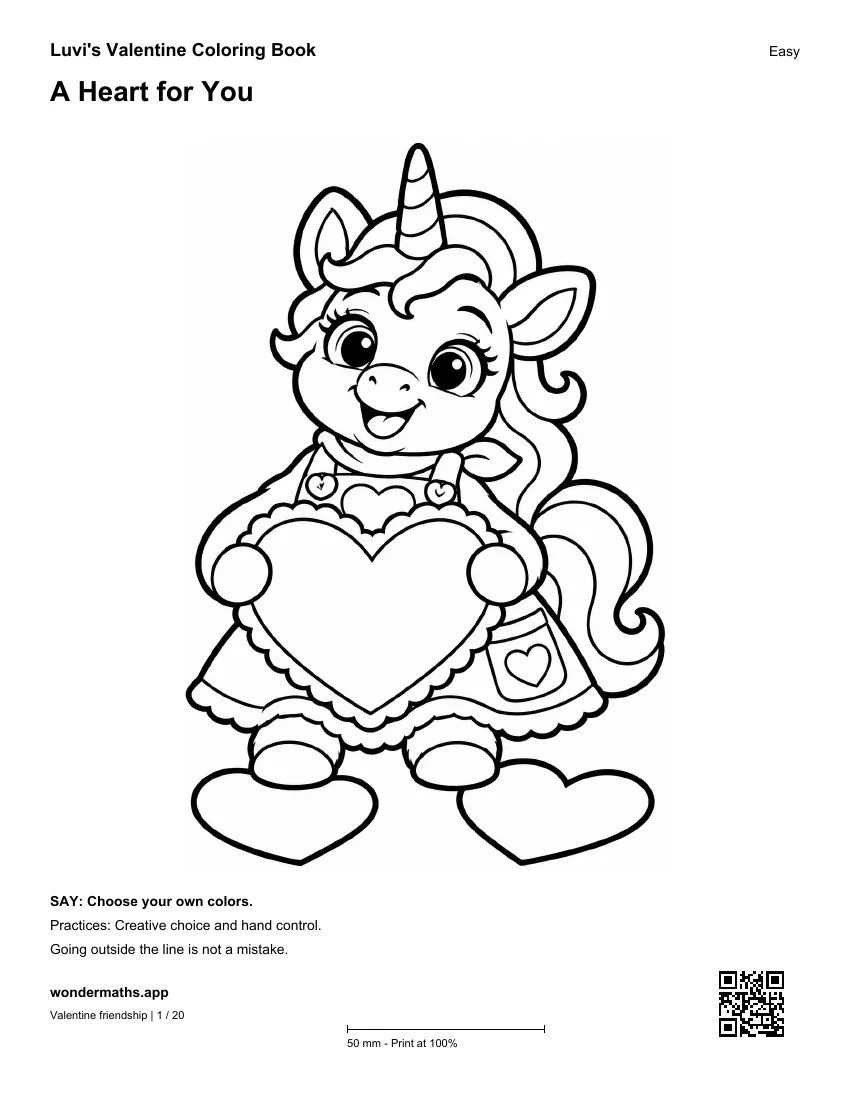
A Heart for You — Valentine coloring page

Choose your page

A Heart for You

Page 1 of 20

Draw with your finger, stylus, or mouse. Erase, undo, and save in this browser. Download a picture to keep your work.

Read & listen with Luvi

Four little stories about trying, sharing, and finding a way together. Open a book, or settle in and listen.