Keep the measure fair.
Compare from the same starting point. When using blocks, keep every block the same size and place them end to end without gaps or overlaps.

A little measure of love
Long ties. Little tools.
Big discoveries together.
Four little measuring adventures in Kova’s workshop.
Color Kova’s workshop, follow a trail, or solve a few little measuring puzzles. Use a finger on the tablet or print a page to share.
Four workshop stories to share with someone you love.
Listen to the story
The story audio couldn’t play. You can read the book or open the transcript.
Find a tie, a toy tool, or a few blocks. Pick one of these six ideas and see what you notice together.
Measure & Compare · L1–L2
Two ties, or two long fabric strips.
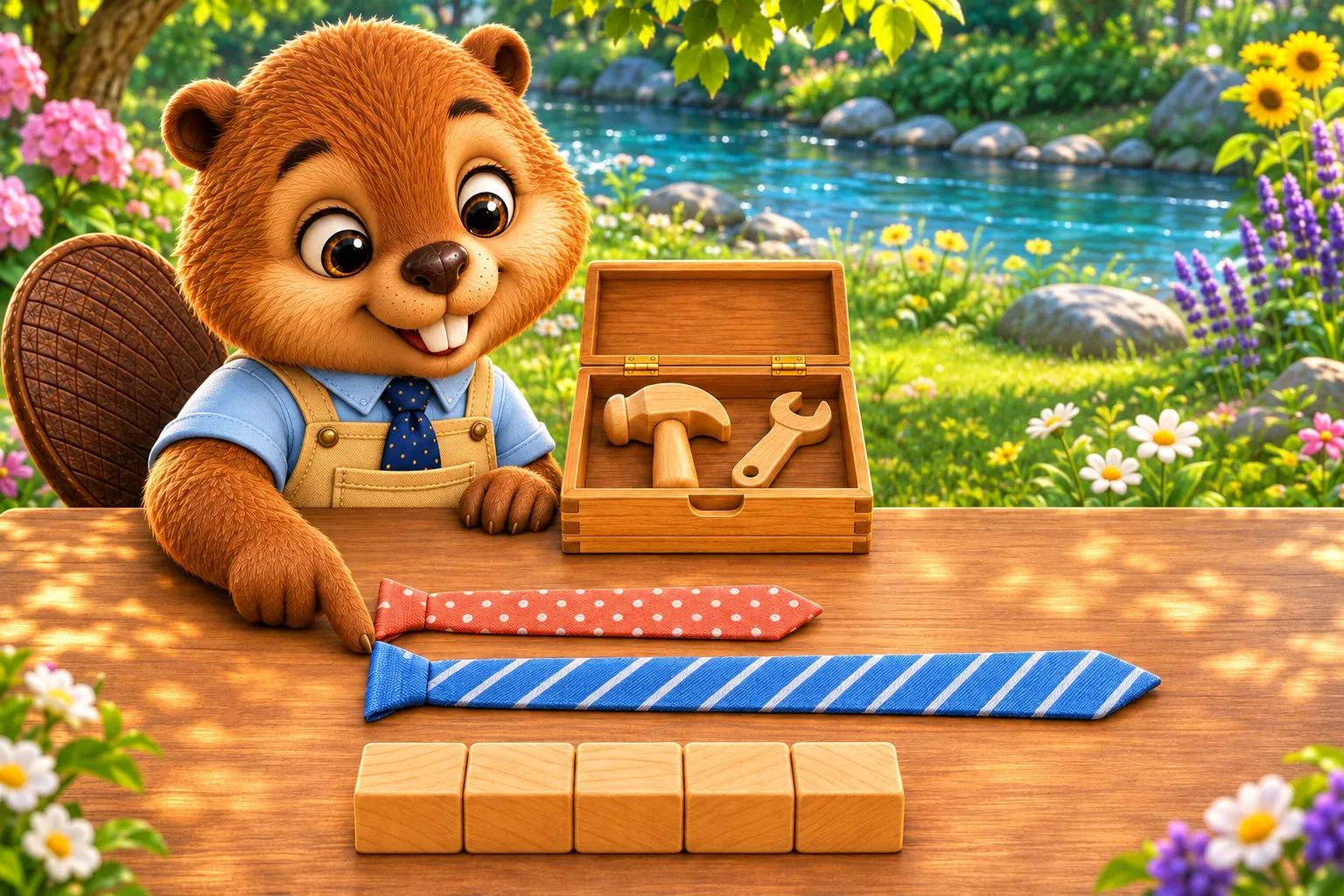
Lay both ties flat. Put the wide tips on the same edge of the table. Follow each tie to its other end.
“Which tie reaches farther? Which is shorter?”
Let your child point. Move one tie away, then bring the starting ends together again to check.
Measure & Compare · L1–L2
A toy hammer or toy wrench and two paper strips. A grown-up prepares one strip the same length as the toy tool and one clearly shorter.
Lay the toy tool flat. Place one end of each strip beside the same end of the tool. Look for a strip that ends in the same place.
“Which strip is the same length as the tool?”
Use a bold difference first. Say “Let’s put the starts together” and compare again.
Measure & Compare · L2
Three ties or fabric strips with different lengths.
Lay the ties flat, with their wide tips on the same starting line. Find the shortest. Place the next one beside it, then the longest.
“Can you show me shortest, longer, and longest?”
Start with two ties. Add the third only when your child wants another turn.
Measure & Compare · L2–L3
A short toy tool and a few identical large blocks.
Lay blocks in a straight row beside the tool. Start at one end. Let the blocks touch with no gaps or overlaps. Count the blocks that reach the other end.
“How many blocks long is this tool?”
Choose an object that fits a whole number of blocks first. If the last block goes past the end, say “between three and four blocks,” for example.
Measure & Compare · L3
A toy tool, paper strips, and a crayon.
Line up a strip with one end of the tool. Mark the other end on the paper. Carry your marked strip to a second toy tool and line up the same start.
“Is this tool shorter, longer, or the same length as our mark?”
A grown-up can hold the paper while the child marks. The mark records the length; the whole strip may be longer.
Measure & Compare · L3–L4
One tie or fabric strip, a paper strip, and a crayon.
Flatten the tie. Mark its length on the paper from a clear starting end. Together, find something in the room that might be the same length. Check with the marked paper.
“What could be about as long as this tie?”
A guess is a beginning. Say “Let’s check together.” An almost-match is a useful discovery too.
The discovery matters more than a correct first guess. Keep the objects in reach and give your child time to look.
Compare from the same starting point. When using blocks, keep every block the same size and place them end to end without gaps or overlaps.
“How could we check?” leaves room to explore. If it feels tricky, return to two very different lengths and line up their starts together.
Use large toy tools or paper tool shapes. A grown-up handles real tools, cutting, and tape measures. Keep long ties and strips on the table, away from necks.
Begin by pointing to longer or shorter. Move on to ordering and counting equal blocks when your child is ready. No reading or written answers are needed from your child.